Dolomites
About this trip.
Two cultures in one walk
San Candido sits in the Süd-Tirol, a German-speaking enclave in northern Italy where the road signs read Innichen, the breakfasts involve rye bread and speck, and the meadows behind the village run up towards the Austrian border. By the end of the week you will have walked over the high Dolomites and into Cortina d'Ampezzo, a town that is unmistakably Italian — the wine comes from the Veneto, the cafés serve aperitivo, and the language switches without much warning. That cultural shift, walked in rather than driven through, is much of the point.
It is a self-guided route, so you carry the notes and a GPS file rather than walking with a guide. Accommodation, luggage transfers and detailed route instructions are all arranged for you.
The route from San Candido to Cortina
The opening day is gentle: a circular walk around San Candido that takes in the valley of the young River Drava, useful for finding your legs after travel. The serious walking begins the next morning, climbing out of town to a remote mountain refuge well above the treeline.
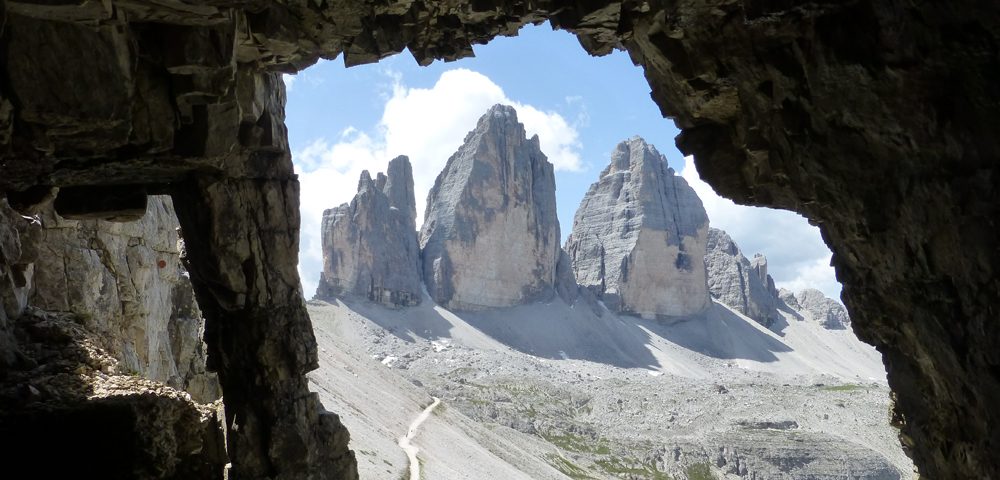
From the refuge the path heads up to the Tre Cime di Lavaredo, three sheer towers rising to about 2,250m and the most famous silhouette in the range. This is the hardest day — past walkers describe roughly eight hours and a lot of climbing — and it drops you down to lakeside Misurina, the linguistic and cultural border. From there you cross the panoramic bowl of mountains that rings Cortina, finishing with a climb to Lagazuoi and its open-air World War I museum, where the trenches and tunnels have been left much as the fighting left them.
Hotels are booked for two nights wherever possible, which means built-in rest days and less repacking. Lunches happen at refuges or village trattorias along the way.
What the walking actually involves
On the full route days you cover 8–18 km in 3½ to 7 hours, with steady ascents on rocky alpine paths. Where a stage proves too much, the route notes flag ski-lifts and local buses that bring the day down to 6–13 km and 2½–4½ hours. Walking poles and a downloaded Pocket Earth map are sensibly considered essential rather than optional. This is mountain walking, not Tuscan strolling — but it isn't technical, and shorter days are built in deliberately.
Bookings, dates and what's included
The full route is seven nights with six days of walking, from £1,545. A six-night version (from £1,415) and two five-night versions cover the shoulder months — June, early July and late September, when the high refuge is closed. The five-night options run from £1,190 if a refuge night is included, or £1,420 if you swap it for a hotel. Extra nights can be added at any stage. Prices cover accommodation, breakfasts, route notes, GPS files, luggage transfers and office support during the trip; flights and most evening meals are extra. The route pairs naturally with the operator's Lake Maggiore walk for anyone planning a longer Italian summer.
The shape of the trip.
What's typically in the price, what isn't.
A general guide for walking holidays of this kind. Check the operator's booking page for the final inclusions on this specific trip.
Typically included
- ✓Hotel accommodation, double or twin en-suite rooms
- ✓Daily breakfast at each hotel
- ✓Luggage transfer between hotels on every walking day
- ✓Detailed route notes with maps and GPX files
- ✓24/7 support line in English for the duration of the trip
Typically not included
- ×Flights to and from the country of travel
- ×Travel insurance (strongly recommended)
- ×Lunches — typically a village picnic or café stop
- ×Some evening meals — depends on the specific itinerary
- ×Alcohol beyond any wine included with set dinners
- ×Optional room or transfer upgrades
Everything you might be wondering.
Q1How hard is it really?
The grading is set by the operator and usually reflects daily distance and total ascent. As a rule of thumb: if you can comfortably manage a 5-6 hour hillwalk at home on a weekend, a moderate-graded route will be fine. Read the day-by-day notes carefully, and train with a loaded pack in the months before.
Q2Can I do this solo?
Yes — self-guided walking holidays are well suited to solo travellers, and some operators waive the single-room supplement on certain departures. The route notes are written for confident independent walkers, and most operators run a 24/7 support line.
Q3Do I need to speak the language?
No. Hotels and restaurants on the route are used to English-speaking walkers. A phrasebook for menus and a few polite basics (hello, thank you, please) is all you really need. The operator's support line speaks English.
Q4Can I bring my dog?
Some routes are dog-friendly, others aren't — it depends on whether all the accommodation on the itinerary accepts dogs. Check with the operator before booking. If you do bring a dog, you'll need a pet passport, up-to-date rabies vaccination, and a lead for villages.
Q5What if it rains?
The route is walkable in rain — your luggage travels ahead regardless, so you'll always arrive somewhere dry. Some trails get slippery in wet weather and the operator's support line can arrange a taxi for any stage if conditions are properly bad.
Q6How do I get there from the UK?
Most routes are reachable by a short flight to a nearby airport, followed by train or transfer. The operator will usually point you at the nearest airport and can advise on rail connections. Some will book train tickets on your behalf for a small fee.
Q7Can I shorten or extend it?
Usually yes. Many operators offer shorter versions of a route as a standalone, and most will add extra nights at the start or end at their own rates. Ask when you enquire — they'll tailor it before booking.
Q8What about cancellation?
Typically a deposit (usually 20-25%) is taken at booking, with the balance due 8-10 weeks before departure. The operator's own terms apply — Mooch doesn't handle the booking or refunds. Travel insurance is strongly recommended.
Three walking holidays, side-by-side.
Other walking holidays on Mooch in the same spirit. All prices per person, from the operator.