Camino Final Stage - Sarria to Santiago
About this trip.
Why Sarria
Sarria is the most popular starting point on the Camino Francés, and the reason is bureaucratic rather than scenic. The Pilgrim's Office in Santiago requires walkers to cover the final 100km to qualify for the Compostela — the Latin certificate issued to those who complete a recognised pilgrim route on foot. Sarria sits just beyond that threshold. Start here, and you earn the certificate.
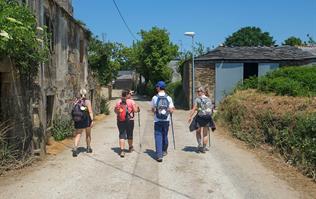
This makes the final stretch busier than the earlier sections of the Camino that cross the meseta or the Pyrenees. You share paths with pilgrims who have walked for weeks from France, and with plenty who, like you, have come just for this last week. That mix is part of the character of these last days, and people who want the long solitude of the full Camino often find this stage too companionable. If company doesn't bother you, it's a fair introduction to a route that otherwise takes a month.
The walk across Galicia
Over seven nights you cover the last 100km to Santiago de Compostela on foot, through the rolling green interior of Galicia. It's a wetter, softer landscape than people often expect from Spain — closer to Atlantic Ireland than to the dry plains further south. You pass through small farming hamlets, cross granite waymarkers carved with the scallop shell, and walk stretches of sunken holloway shaded by eucalyptus and oak.
Days are moderate rather than punishing. Luggage is transferred between accommodations, so you walk with a daypack, and that makes all the difference on consecutive walking days.
Arriving in Santiago
The final approach is the part most pilgrims talk about afterwards. You come down through the outskirts, past Monte do Gozo where walkers traditionally catch their first view of the cathedral spires, and into the old town. The Praza do Obradoiro, in front of the cathedral, is where the Camino ends. Pilgrims arrive throughout the day, and the square has a particular atmosphere — a mixture of relief, emotion, and people quietly sitting with their boots off, watching newcomers limp in.
Booking and logistics
Macs Adventure runs this as a self-guided trip over 8 days and 7 nights. You get route notes and GPS tracking through the Macs app, pre-booked accommodation in small hotels and guesthouses along the way, and daily luggage transfer between stops. Food is on your own, which suits the route — Galician cooking is generally good value and hearty, with pulpo a feira and a glass of Albariño being the regional specialities worth asking for.
It suits walkers with reasonable fitness rather than serious long-distance hikers, and pairs well with a couple of extra nights in Santiago at the end, to see the city properly once the walking is done.
The shape of the trip.
What's typically in the price, what isn't.
A general guide for walking holidays of this kind. Check the operator's booking page for the final inclusions on this specific trip.
Typically included
- ✓Hotel accommodation, double or twin en-suite rooms
- ✓Daily breakfast at each hotel
- ✓Luggage transfer between hotels on every walking day
- ✓Detailed route notes with maps and GPX files
- ✓24/7 support line in English for the duration of the trip
Typically not included
- ×Flights to and from the country of travel
- ×Travel insurance (strongly recommended)
- ×Lunches — typically a village picnic or café stop
- ×Some evening meals — depends on the specific itinerary
- ×Alcohol beyond any wine included with set dinners
- ×Optional room or transfer upgrades
Everything you might be wondering.
Q1How hard is it really?
The grading is set by the operator and usually reflects daily distance and total ascent. As a rule of thumb: if you can comfortably manage a 5-6 hour hillwalk at home on a weekend, a moderate-graded route will be fine. Read the day-by-day notes carefully, and train with a loaded pack in the months before.
Q2Can I do this solo?
Yes — self-guided walking holidays are well suited to solo travellers, and some operators waive the single-room supplement on certain departures. The route notes are written for confident independent walkers, and most operators run a 24/7 support line.
Q3Do I need to speak the language?
No. Hotels and restaurants on the route are used to English-speaking walkers. A phrasebook for menus and a few polite basics (hello, thank you, please) is all you really need. The operator's support line speaks English.
Q4Can I bring my dog?
Some routes are dog-friendly, others aren't — it depends on whether all the accommodation on the itinerary accepts dogs. Check with the operator before booking. If you do bring a dog, you'll need a pet passport, up-to-date rabies vaccination, and a lead for villages.
Q5What if it rains?
The route is walkable in rain — your luggage travels ahead regardless, so you'll always arrive somewhere dry. Some trails get slippery in wet weather and the operator's support line can arrange a taxi for any stage if conditions are properly bad.
Q6How do I get there from the UK?
Most routes are reachable by a short flight to a nearby airport, followed by train or transfer. The operator will usually point you at the nearest airport and can advise on rail connections. Some will book train tickets on your behalf for a small fee.
Q7Can I shorten or extend it?
Usually yes. Many operators offer shorter versions of a route as a standalone, and most will add extra nights at the start or end at their own rates. Ask when you enquire — they'll tailor it before booking.
Q8What about cancellation?
Typically a deposit (usually 20-25%) is taken at booking, with the balance due 8-10 weeks before departure. The operator's own terms apply — Mooch doesn't handle the booking or refunds. Travel insurance is strongly recommended.
Three walking holidays, side-by-side.
Other walking holidays on Mooch in the same spirit. All prices per person, from the operator.