Walk Normandy’s D-Day Beaches
A history-walk format we don't see often: Inntravel pairs the D-Day landing beaches with the Bayeux Tapestry, Mont St Michel, and proper Norman cooking. Suits readers wanting context rather than mileage.
About this trip.
Five beaches and the country behind them
At dawn on 6 June 1944, five stretches of Norman coast — Utah, Omaha, Gold, Juno and Sword — became the staging ground for Operation Overlord, the largest amphibious invasion ever mounted. Eighty years on, the landing sites are still the reason most visitors come, but the surrounding country has plenty going on of its own. Fishing boats run out to scallop, mussel and oyster beds. Racehorses are sometimes worked along Utah Beach at low tide. Inland, the bocage — that distinctive Norman patchwork of hedgerows, pasture and small woods — closes in around quiet farm lanes. The cooking is unapologetically rich: cider and calvados in the cream sauces, oozing Camembert, fish landed that morning.
From Sainte-Marie-du-Mont to Bayeux
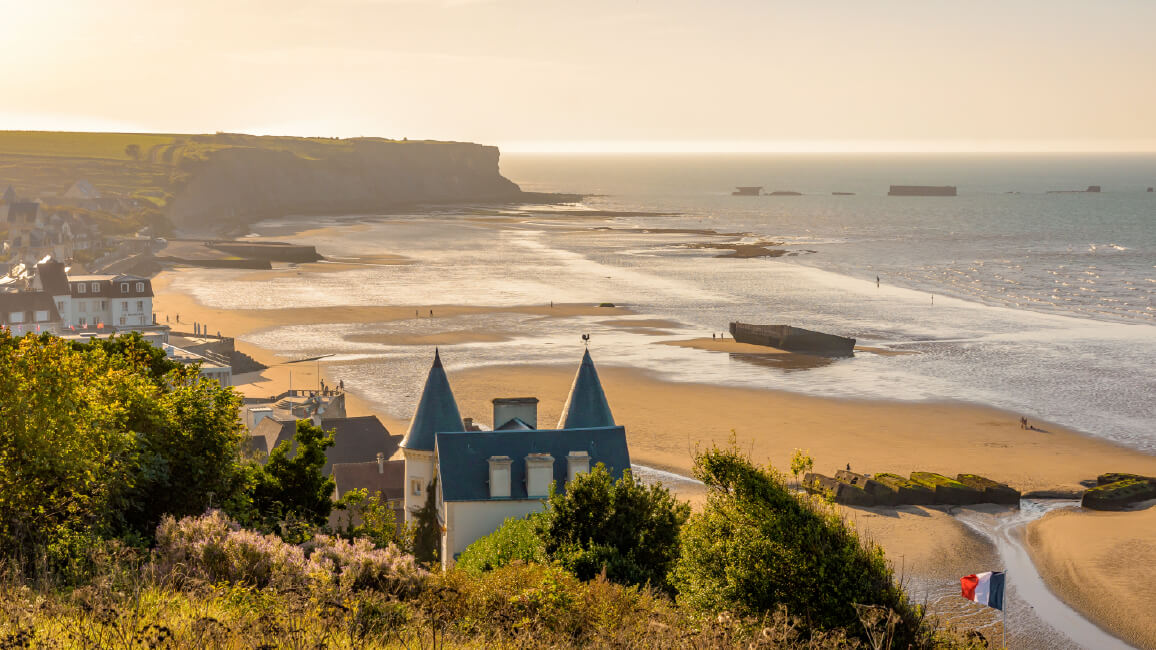
The walk runs in seven days from the western end of the landings towards Bayeux. The first night is at Hotel le Grand Hard near Sainte-Marie-du-Mont, with a 12km loop around Utah Beach the following day — easy farm tracks, dunes at high tide, and the Utah Beach D-Day Landing Museum at the far point. Day 2 starts with a short transfer to Saint-Laurent-sur-Mer for a walk along Omaha and through the Normandy American Cemetery, before the bocage and the small fishing town of Port-en-Bessin (12km, 200m of ascent). Day 3 is the longest at 15km — a transfer to Arromanches-les-Bains, then Gold Beach and the rusting remains of Port Winston, the artificial harbour assembled here in the days after the landings. Later in the week the route picks up the British Memorial at Ver sur Mer, follows a canal path into the centre of Caen, and finishes in Bayeux, whose 11th-century medieval heart largely escaped the damage of 1944.
Bookings and what to expect
This is a Grade 1-2 holiday: 5-15km a day on country tracks, coastal paths and beach, with the occasional hill but nothing testing. Inntravel grade it easy-to-moderate, which feels about right. Seven nights' accommodation runs across one country inn, two 3-star hotels and a 4-star — practical and well-placed rather than luxurious. Seven breakfasts and two dinners are included, alongside luggage transfers between hotels, written route notes and GPS navigation. You walk, eat and visit museums at your own pace; the operator handles the logistics but not the day. Departures run any day of the week from 1 April to 31 October 2026, with prices starting at £1,492 per person. Rail travel from London can be arranged, as can flights with connecting transfers, or just the transfers if you'd rather sort the travel yourself.
The shape of the trip.
What's typically in the price, what isn't.
A general guide for walking holidays of this kind. Check the operator's booking page for the final inclusions on this specific trip.
Typically included
- ✓Hotel accommodation, double or twin en-suite rooms
- ✓Daily breakfast at each hotel
- ✓Luggage transfer between hotels on every walking day
- ✓Detailed route notes with maps and GPX files
- ✓24/7 support line in English for the duration of the trip
Typically not included
- ×Flights to and from the country of travel
- ×Travel insurance (strongly recommended)
- ×Lunches — typically a village picnic or café stop
- ×Some evening meals — depends on the specific itinerary
- ×Alcohol beyond any wine included with set dinners
- ×Optional room or transfer upgrades
Everything you might be wondering.
Q1How hard is it really?
The grading is set by the operator and usually reflects daily distance and total ascent. As a rule of thumb: if you can comfortably manage a 5-6 hour hillwalk at home on a weekend, a moderate-graded route will be fine. Read the day-by-day notes carefully, and train with a loaded pack in the months before.
Q2Can I do this solo?
Yes — self-guided walking holidays are well suited to solo travellers, and some operators waive the single-room supplement on certain departures. The route notes are written for confident independent walkers, and most operators run a 24/7 support line.
Q3Do I need to speak the language?
No. Hotels and restaurants on the route are used to English-speaking walkers. A phrasebook for menus and a few polite basics (hello, thank you, please) is all you really need. The operator's support line speaks English.
Q4Can I bring my dog?
Some routes are dog-friendly, others aren't — it depends on whether all the accommodation on the itinerary accepts dogs. Check with the operator before booking. If you do bring a dog, you'll need a pet passport, up-to-date rabies vaccination, and a lead for villages.
Q5What if it rains?
The route is walkable in rain — your luggage travels ahead regardless, so you'll always arrive somewhere dry. Some trails get slippery in wet weather and the operator's support line can arrange a taxi for any stage if conditions are properly bad.
Q6How do I get there from the UK?
Most routes are reachable by a short flight to a nearby airport, followed by train or transfer. The operator will usually point you at the nearest airport and can advise on rail connections. Some will book train tickets on your behalf for a small fee.
Q7Can I shorten or extend it?
Usually yes. Many operators offer shorter versions of a route as a standalone, and most will add extra nights at the start or end at their own rates. Ask when you enquire — they'll tailor it before booking.
Q8What about cancellation?
Typically a deposit (usually 20-25%) is taken at booking, with the balance due 8-10 weeks before departure. The operator's own terms apply — Mooch doesn't handle the booking or refunds. Travel insurance is strongly recommended.
Three walking holidays, side-by-side.
Other walking holidays on Mooch in the same spirit. All prices per person, from the operator.