Lakes & Mountains of Slovenia
About this trip.
Kranjska Gora and the Julian Alps
Kranjska Gora is a small alpine town close enough to the Italian and Austrian borders that you can cross between countries in a morning. Once the snow goes and the skiers leave, the limestone spires of the Julian Alps come into their own — sharper and quieter than the better-known ranges further west, with glacial lakes the colour of bottle glass and waterfalls that drop hundreds of feet through pine forest. This walking week uses the town as a base for seven nights at Hotel Kompas, a comfortable mountain lodge with a wellness centre worth using once the day's walking is done.
The walking week
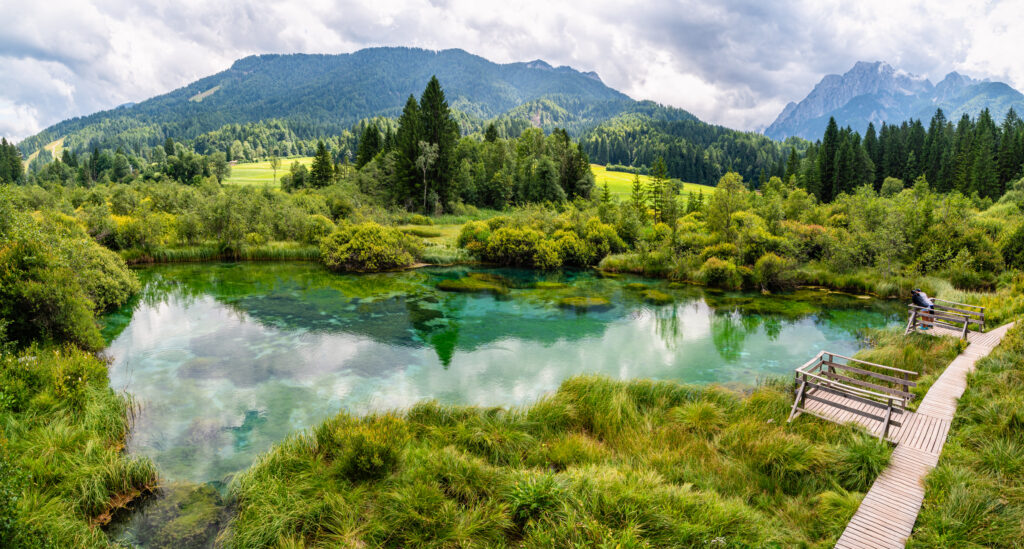
Five days on foot, graded moderate at 3-4mph (5-6kph), low altitude with good paths and some steep ascents. Distances range from 7km / 4.3 miles on the easier days up to 17.9km / 10.6 miles on the opening hike, which heads into the Zelenci wetlands reserve — green pools, breeding birds, carnivorous plants — and on through Planica Valley beneath the famous ski-jumping hills.
Other days take in the twin waterfalls below Špik mountain at Gozd Martuljek, where the upper falls drop more than 110m down a sheer cliff; a longer day combining Lake Bled with Vintgar Gorge and a circuit around Lake Bohinj; a cross-border outing to the glacial Fusine Lakes in Italy and the quieter Možnice Gorge on the way back; and a climb from the switchbacks of the Vršič Pass — Slovenia's highest road — up to Slemenova Špica, a grassy summit looking across to the pyramidal Jalovec, sometimes called the Slovenian Matterhorn. A cable car day up to the Kamniška Bistrica valley rounds things out.
Bookings and practical detail
Seven nights at Hotel Kompas (or similar) in superior rooms, all breakfasts and two dinners — the welcome meal on arrival and another later in the week. Everything in between is moved by private minivan and led by a tour leader who knows the trails properly, which matters in this kind of terrain where the difference between the obvious path and the better one isn't always marked.
Group arrival and departure transfers are available. Local taxes of roughly €3.50 per night are payable on arrival and aren't included in the price. Single rooms on request, and travel insurance, visas and vaccinations remain the traveller's responsibility. If a week isn't enough, the trip pairs neatly with the Bosnia & Beyond itinerary, which can be combined with this one.
Best suited to walkers comfortable with five consecutive days of moderate hiking and the odd steep section, and who'd rather follow a knowledgeable leader through a varied set of trails than work out the logistics themselves. Pre-tour nights in Kranjska Gora or Ljubljana can be arranged through the sales team if you'd like a slower start.
The shape of the trip.
What's typically in the price, what isn't.
A general guide for walking holidays of this kind. Check the operator's booking page for the final inclusions on this specific trip.
Typically included
- ✓Hotel accommodation, double or twin en-suite rooms
- ✓Daily breakfast at each hotel
- ✓Luggage transfer between hotels on every walking day
- ✓Detailed route notes with maps and GPX files
- ✓24/7 support line in English for the duration of the trip
Typically not included
- ×Flights to and from the country of travel
- ×Travel insurance (strongly recommended)
- ×Lunches — typically a village picnic or café stop
- ×Some evening meals — depends on the specific itinerary
- ×Alcohol beyond any wine included with set dinners
- ×Optional room or transfer upgrades
Everything you might be wondering.
Q1How hard is it really?
The grading is set by the operator and usually reflects daily distance and total ascent. As a rule of thumb: if you can comfortably manage a 5-6 hour hillwalk at home on a weekend, a moderate-graded route will be fine. Read the day-by-day notes carefully, and train with a loaded pack in the months before.
Q2Can I do this solo?
Yes — self-guided walking holidays are well suited to solo travellers, and some operators waive the single-room supplement on certain departures. The route notes are written for confident independent walkers, and most operators run a 24/7 support line.
Q3Do I need to speak the language?
No. Hotels and restaurants on the route are used to English-speaking walkers. A phrasebook for menus and a few polite basics (hello, thank you, please) is all you really need. The operator's support line speaks English.
Q4Can I bring my dog?
Some routes are dog-friendly, others aren't — it depends on whether all the accommodation on the itinerary accepts dogs. Check with the operator before booking. If you do bring a dog, you'll need a pet passport, up-to-date rabies vaccination, and a lead for villages.
Q5What if it rains?
The route is walkable in rain — your luggage travels ahead regardless, so you'll always arrive somewhere dry. Some trails get slippery in wet weather and the operator's support line can arrange a taxi for any stage if conditions are properly bad.
Q6How do I get there from the UK?
Most routes are reachable by a short flight to a nearby airport, followed by train or transfer. The operator will usually point you at the nearest airport and can advise on rail connections. Some will book train tickets on your behalf for a small fee.
Q7Can I shorten or extend it?
Usually yes. Many operators offer shorter versions of a route as a standalone, and most will add extra nights at the start or end at their own rates. Ask when you enquire — they'll tailor it before booking.
Q8What about cancellation?
Typically a deposit (usually 20-25%) is taken at booking, with the balance due 8-10 weeks before departure. The operator's own terms apply — Mooch doesn't handle the booking or refunds. Travel insurance is strongly recommended.
Three walking holidays, side-by-side.
Other walking holidays on Mooch in the same spirit. All prices per person, from the operator.