Camino Frances from Pamplona to Logrono (1 week)

About this trip.
Comparing firms? Every Camino holiday on Mooch, route by route.
Before you book: Walking holidays vs cycling holidays — when each one is the right answer · Which Camino route is right for you — an honest opinion on each of the seven
Pamplona to Logroño over a week
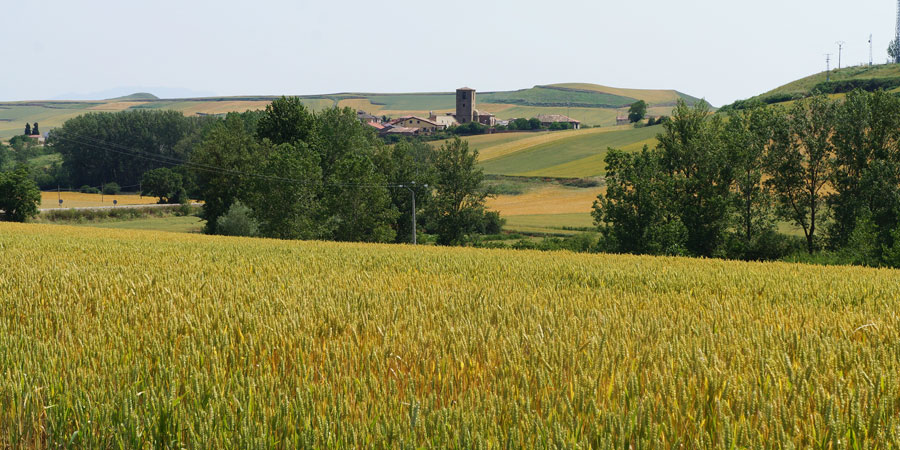
This 95 km section of the Camino Francés runs from Pamplona to Logroño, capital of the La Rioja wine region. It is a quieter stretch than the final approach to Santiago de Compostela. You cross Navarra's mountains and La Rioja's red-earth vineyards, passing medieval bridges, castles, historic churches and villages along the way.
Pamplona, also called Iruña in Basque, is known for the San Fermín bull run each July. After a night in the city, the Camino climbs to the Alto del Perdón, the Hill of Forgiveness. A pilgrim sculpture stands on the pass, and there are 360-degree views back over Pamplona and the valley.
The stages through Navarra
From the Alto del Perdón you descend to Puente la Reina, a town of medieval alleys with an 11th-century bridge over the River Arga. The next day is mostly on peaceful tracks through rolling farmland, past olive groves, cereal crops and vineyards. You pass the hilltop village of Cirauqui, with its winding medieval streets, and finish in the historic town of Estella-Lizarra.
Just outside Estella is Bodegas Irache, with its wine museum and free wine fountain, where you can stop for a sip of the local Rioja. The walk on to Los Arcos is mostly on good tracks. From Villamayor de Monjardín to Los Arcos you cover about 12 km without passing a single village, so carry plenty of water and some snacks.
Into La Rioja
The last stage crosses rolling countryside out of Navarra and into La Rioja. It passes the ruins of Clavijo Castle before reaching Logroño, which has one of the best tapas scenes on the Camino. Calle Laurel is the place to try Rioja-style specialities.
If you would like a gentler pace, you can split the long stage from Los Arcos to Logroño into two walks of 18 km and 10 km. You then stay overnight in a period hotel in the hilltop village of Viana.
Where you stay and getting there
You can choose from three types of accommodation. Standard hotels and guesthouses are up to 3-star, in town centres and close to the trail. Country Cottages are restored rural homes and farmhouses, known for their food. The Superior Collection includes 4- and 5-star hotels, boutique guesthouses and heritage Parador hotels. All rooms are en-suite. The country and superior options aren't available everywhere, so on some nights you may stay in standard accommodation instead. If your accommodation is occasionally a few kilometres from the trail, transport to and from it is arranged for you.
For getting to Pamplona, the operator lists bus and train connections from the airports at Bilbao, Biarritz, Santander and Madrid. Private transfers can also be arranged. The route can be tailored to suit you, and you can walk or cycle it.
The shape of the trip.
Everything you might be wondering.
Q1How hard is it really?
The grading is set by the operator and usually reflects daily distance and total ascent. As a rule of thumb: if you can comfortably manage a 5-6 hour hillwalk at home on a weekend, a moderate-graded route will be fine. Read the day-by-day notes carefully, and train with a loaded pack in the months before.
Q2Can I do this solo?
Yes — self-guided walking holidays are well suited to solo travellers, and some operators waive the single-room supplement on certain departures. The route notes are written for confident independent walkers, and most operators run a 24/7 support line.
Q3Do I need to speak the language?
No. Hotels and restaurants on the route are used to English-speaking walkers. A phrasebook for menus and a few polite basics (hello, thank you, please) is all you really need. The operator's support line speaks English.
Q4Can I bring my dog?
Some routes are dog-friendly, others aren't — it depends on whether all the accommodation on the itinerary accepts dogs. Check with the operator before booking. If you do bring a dog, you'll need a pet passport, up-to-date rabies vaccination, and a lead for villages.
Q5What if it rains?
The route is walkable in rain — your luggage travels ahead regardless, so you'll always arrive somewhere dry. Some trails get slippery in wet weather and the operator's support line can arrange a taxi for any stage if conditions are properly bad.
Q6How do I get there from the UK?
Most routes are reachable by a short flight to a nearby airport, followed by train or transfer. The operator will usually point you at the nearest airport and can advise on rail connections. Some will book train tickets on your behalf for a small fee.
Q7Can I shorten or extend it?
Usually yes. Many operators offer shorter versions of a route as a standalone, and most will add extra nights at the start or end at their own rates. Ask when you enquire — they'll tailor it before booking.
Q8What about cancellation?
Typically a deposit (usually 20-25%) is taken at booking, with the balance due 8-10 weeks before departure. The operator's own terms apply — Mooch doesn't handle the booking or refunds. Travel insurance is strongly recommended.
Three walking holidays, side-by-side.
The two closest walking holidays on Mooch, both on the Camino. Prices are the operators' own, per person.