Australia's Indian Pacific Perth - Sydney
Australia's Indian Pacific takes 65 hours across the Nullarbor — GRJ books proper sleeper cabins and the side excursions in Adelaide, Cook and Kalgoorlie. Worth the flight alone.
About this trip.
Three nights on a train
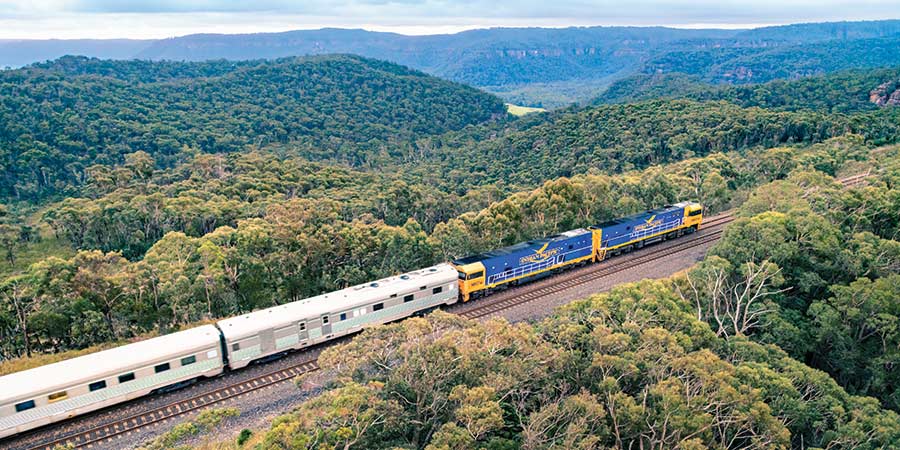
The Indian Pacific runs the width of Australia — Perth to Sydney, roughly 4,352 kilometres, with the Nullarbor Plain in the middle. It holds one of the longest continuous stretches of straight track anywhere in the world, and for the better part of a day the train rolls through country so flat and unvaried that the horizon becomes an abstraction. That sounds dull on paper. It isn't. The sheer scale of it does something to you.
This route runs eastbound, Perth to Sydney, arriving into Sydney Central after three nights on board. Westbound services run too, but the title here is clear — you're heading for the east coast.
What the route looks like
Out of Perth, the train climbs through the Darling Range and into the goldfields, stopping at Kalgoorlie — a working frontier town, still mining, unvarnished. Then the Nullarbor: a treeless plain the size of England, with the whistle-stop at Cook in the middle of it, where passengers step off to stretch their legs next to a sign reading "If you're crook, come to Cook". Adelaide comes next, with off-train excursions out into the Barossa and the Adelaide Hills. Then Broken Hill in outback New South Wales, the Blue Mountains, and finally Sydney.
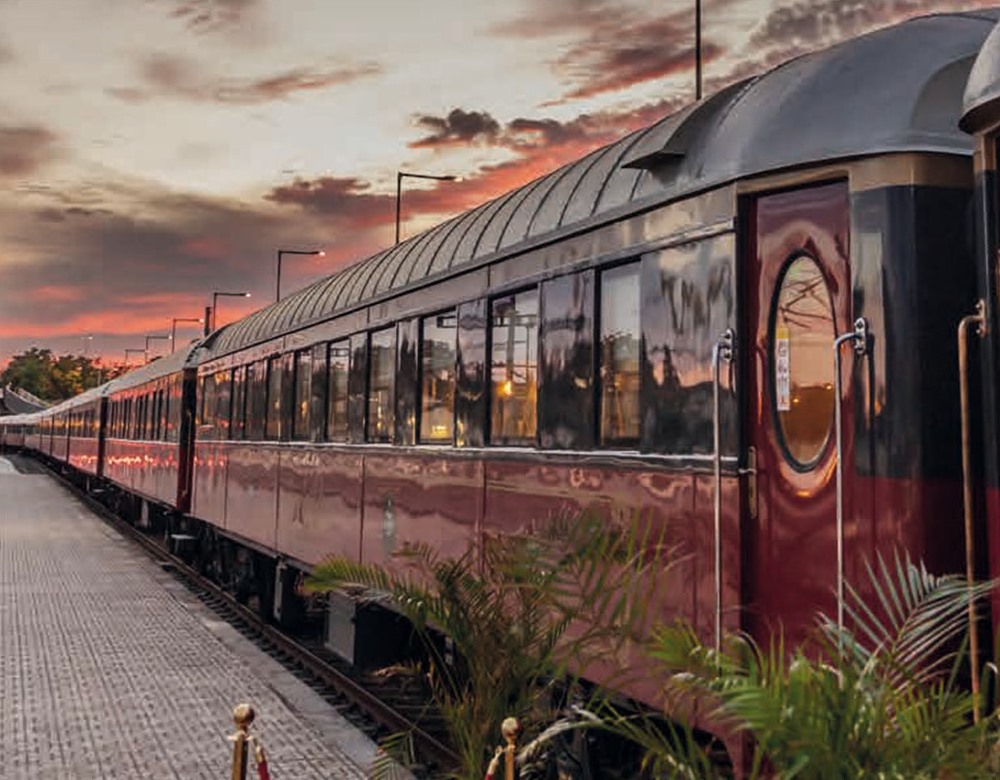
The Indian Pacific is a hotel on wheels rather than a sightseeing train. The pace is steady, meals are proper sit-down affairs in the dining car, and the cabins are comfortable rather than lavish. The off-train excursions at Kalgoorlie, Cook, Adelaide and Broken Hill are the main chances to get out and walk.
Booking and practicalities
This is sold as a Tailormade Rail Holiday, which means the itinerary is built around the fixed Indian Pacific schedule but the rest is flexible — nights in Perth and Sydney either side, cabin category, and extensions further into Australia if you want them. The rail portion itself is the Indian Pacific's scheduled Perth-Sydney service; everything around it is tailored to you.
It suits travellers who think three nights on a train sounds like a holiday rather than a logistical inconvenience. If you'd rather fly, this isn't the trip for you. If the idea of watching Australia unfold through a window, with a glass of something in your hand and nowhere in particular to be, is appealing — this is exactly the trip for you.
The shape of the trip.
What's typically in the price, what isn't.
A general guide for rail holidays of this kind. Check the operator's booking page for the final inclusions on this specific trip.
Typically included
- ✓Rail tickets on the published route, in the ticket class booked
- ✓Hotel accommodation between rail days, breakfast included
- ✓A tour manager throughout on escorted departures
- ✓Luggage handling between hotels on escorted tours
- ✓Some meals — typically breakfasts and a few set dinners; check the day-by-day
- ✓Any included excursions or entrance fees listed on the itinerary
Typically not included
- ×Flights to and from the start city
- ×Travel insurance with rail-protection cover (strongly recommended)
- ×Most lunches and some evening meals — eat at stations or in town
- ×Upgrades: first-class legs, sleeper cabin upgrades, single rooms on shared departures
- ×Drinks on board beyond anything stated in the itinerary
- ×Tips for the tour manager (customary but discretionary)
Everything you might be wondering.
Q1Do I have to change trains?
On most escorted tours, yes — the route is the point, not a single through-train. A tour manager handles the connections and your luggage. Independent itineraries come with pre-booked tickets and detailed routing, but you work the changes yourself.
Q2Are meals included?
Breakfasts at hotels are usually included. Dinners and lunches vary by tour. Many scenic day services have a dining car or trolley you can pay for on board. Check the day-by-day — escorted tours list every meal that's included.
Q3Is luggage handled?
On escorted tours your main bag is moved between hotels while you carry a day bag on the train. On independent itineraries you move your own luggage — pack a case you can lift onto a train without help.
Q4First class or second?
First class on European trains is wider seats, quieter carriages, sometimes complimentary drinks. Second class is perfectly fine and about a third cheaper. Upgrades to first are usually £50-150 per leg on longer routes.
Q5Can I travel solo?
Escorted rail tours suit solo travellers well — there's a tour manager, a set schedule, and shared hotel dinners most nights. Single-room supplements apply (typically £300-600 on a 10-day tour). A handful of departures are marked 'no single supplement' — watch the operator's calendar if you want to save.
Q6Is it slower than flying?
Yes, and that's the point. London to Zurich by train is 8 hours via Paris and the TGV, versus 2 hours in the air plus 3 hours of airport on each side. The difference is how you arrive — rested, in the middle of the city, having watched the journey.
Q7What if a train is cancelled?
Escorted tours have tour-manager contingency — the operator rebooks and absorbs the cost. Independent itineraries depend on your ticket type (flexible versus advance) and whether you have rail-protection insurance. Take it.
Q8What about cancellation?
Typically a 20-25% deposit at booking, balance due 8-10 weeks before departure. Rail tickets are a sunk cost once issued, which matters on longer trips. Travel insurance with rail cover is sensible.
Three rail holidays, side-by-side.
Other rail holidays on Mooch in the same spirit. All prices per person, from the operator.